Cybersecurity briefing
/
feb 16, 2025
The Gap Between Approved AI and Authorized Data Use
Approving an AI tool isn't the same as authorizing every data transfer into it. Jazz Security offers a model for tested, accountable controls.
/
AUTHOR

Jeff Dyer
Overview
Approving an AI application answers a procurement question. It does not answer whether an employee should send a particular document, spreadsheet, or conversation into it. As organizations expand AI adoption, security programs need to translate acceptable-use policies into decisions about individual data transfers, with enough context to protect sensitive information without obstructing legitimate work.
Jazz Security’s September discussion of GenAI data protection highlights the distinction between sanctioned applications and actual employee usage. The broader architectural lesson is that an application inventory and a data protection policy solve different problems. Organizations need both, connected through controls that evaluate the activity taking place.
Approving the Tool Does Not Authorize Every Use
A policy that names approved AI products leaves several questions unresolved. Which accounts are authorized? What information may be submitted? For what purpose? Under what conditions?
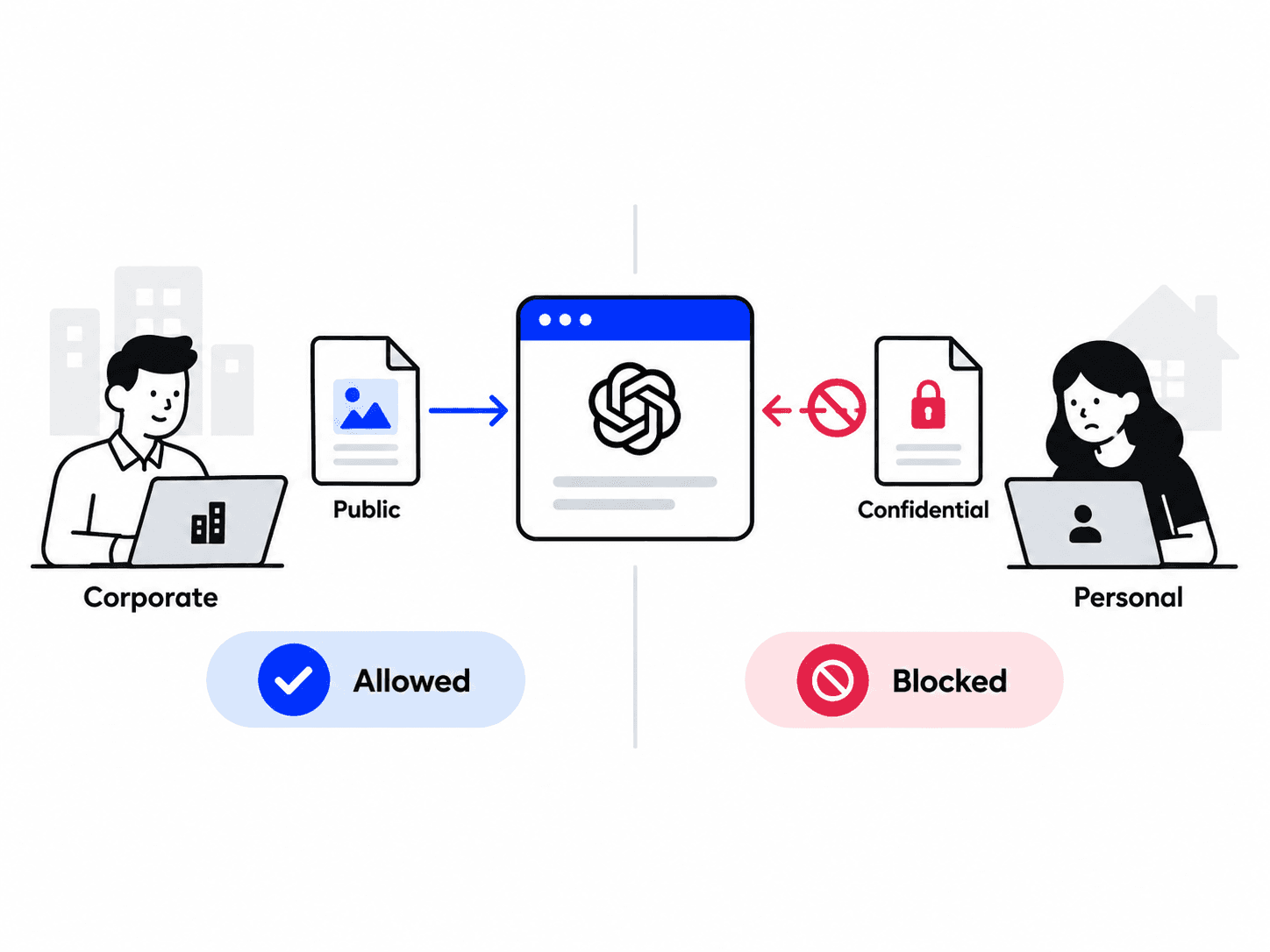
Consider a hypothetical law firm that approves an enterprise AI workspace. An attorney uses it to summarize a publicly available court opinion. Later, the same attorney opens a personal account and uploads privileged material from an active matter.
The application name has not changed. The security decision should.
Even within the corporate workspace, approval may depend on the information and its intended use. A contract permitting certain processing does not automatically authorize every employee to submit every client document.
The operational unit of approval should therefore be the transfer: specific information moving to a specific destination for a specific purpose. Tool approval establishes the permitted environment. Transfer policy establishes what employees may do within it.
Define the Decision Before Choosing the Enforcement
A practical transfer decision combines four questions:
Data: What information is moving, and what obligations apply?
Destination: Which service, account, tenant, or recipient will receive it?
Purpose: Does the action belong to an authorized business workflow?
Control: Can the organization observe and enforce the required response?
These questions should produce a decision that employees and analysts can understand.
For example, uploading a public product brochure to an approved corporate workspace may be permitted. Sending identifiable customer records to a personal account may require blocking. Submitting an internal document with uncertain classification may warrant clarification or review before proceeding.
The organization must define those outcomes. A product can gather context and implement supported controls, but it should not become the source of business authorization simply because it can assign a risk score.
An ambiguous policy remains ambiguous when automated.

Choose Responses That Resolve the Actual Uncertainty
Allowing and blocking are necessary outcomes, but they are not the only useful responses.
A warning can help an employee recognize a mistake before repeating it. A justification request can establish why an unusual transfer is necessary. Human approval may be appropriate when an exception requires an accountable decision.
Those responses have different meanings. A warning that permits the action is not prevention. A recorded justification is not proof that the transfer was authorized. An exception should identify who approved it, its scope, and when it expires.
Teams should also decide which risks cannot be overridden. A workflow involving restricted client information should not become acceptable merely because an employee enters “needed for productivity.”
The objective is proportionate enforcement with clear authority behind it.
Separate Visibility from Control
A system may discover an AI application without seeing the information submitted to it. It may observe a transfer without distinguishing a personal account from a corporate one. It may identify sensitive content but lack an enforcement point for that particular workflow.
Treating these capabilities as interchangeable creates false confidence.
Evaluation should separate application discovery, transfer visibility, contextual investigation, and prevention. Each answers a different question, and each needs evidence.
Jazz is relevant at the endpoint data-movement layer. Its public documentation describes visibility into supported GenAI paste and upload activity, differentiated responses for corporate and personal accounts, and interventions including nudges and sensitive-content blocking. That creates a direct implementation example for transfer-level policy, subject to validation of the applications, operating systems, and actions in scope.
Complementary controls still matter. Identity administration establishes corporate access. Application settings govern the approved workspace. Data classification helps identify handling requirements. Endpoint enforcement addresses observable employee actions. The architecture should assign responsibility to each layer and document the gaps between them.

Test Decisions, Not Just Detections
A useful proof of value starts with representative business tasks and expected outcomes.
Use synthetic or appropriately sanitized test data. Repeat the same task across corporate and personal accounts, browser and desktop applications, pasted text and file uploads. Change one condition at a time so the team can determine what caused the decision.
A successful test should establish more than whether an alert appeared. Did the system identify the relevant destination? Did it recognize the information correctly? Did the required response occur before the transfer completed? Could an analyst explain the outcome?
Test legitimate work with equal care. A control that reliably blocks prohibited transfers but repeatedly interrupts approved tasks will generate pressure for broad exceptions.
Investigation quality also matters. Jazz describes Melody presenting evidence and reasoning across data, systems, people, and business context. Organizations evaluating that approach should check whether those explanations are accurate, reviewable, and useful when a decision is challenged.
Exceptions Reveal Architecture Problems
Repeated exceptions should prompt investigation of the operating model.
Employees may lack an approved tool for a necessary task. The permitted workspace may be difficult to use. A classification policy may be too broad. The enforcement mechanism may be unable to distinguish two materially different destinations.
Those are different problems requiring different corrections.
Review exceptions alongside unsupported workflows and employee feedback. Assign an owner to each unresolved gap. Where direct prevention is unavailable, determine whether another control can address the requirement or whether the organization must explicitly accept the residual risk.
The practical lesson is to connect AI policy with the moment information moves. Define the permitted data, destination, and purpose; validate the enforcement; and make the decision explainable. An approved application list becomes substantially more useful when it leads to a tested, accountable data-transfer policy.
/
BLOG


