Insights
/
feb 16, 2025
Two Actively Exploited SonicWall SMA1000 Flaws Demand Immediate Action
SonicWall confirms active exploitation of two SMA1000 zero-days (CVE-2026-83548, CVE-2026-83549) enabling unauthenticated remote command execution.
/
AUTHOR

Jeff Dyer

Cybersecurity Briefing | September 2, 2026
SonicWall has confirmed exploitation of two vulnerabilities that can be chained against internet-facing remote-access appliances, making patch speed and network-device oversight the immediate priorities.
SonicWall has released hotfixes for two newly disclosed SMA1000 vulnerabilities after observing exploitation in the wild. The SonicWall security advisory covers CVE-2026-83548 and CVE-2026-83549, two flaws affecting secure remote-access gateways that often sit directly at an organization’s perimeter. Current reporting indicates attackers may chain the vulnerabilities to achieve unauthenticated remote code execution.
CVE-2026-83548 is the more severe of the two. SonicWall assigned it a CVSS score of 10.0 and describes it as a pre-authentication server-side request forgery vulnerability in the Appliance Work Place interface. A remote attacker can exploit the flaw without credentials to reach sensitive functionality and perform unauthorized operations.
CVE-2026-83549 is an operating-system command-injection vulnerability in the Appliance Management Console. It carries a CVSS score of 7.8 and requires authentication when considered independently. Successful exploitation allows arbitrary operating-system commands and can lead to remote code execution. Because SonicWall says it observed exploitation of both vulnerabilities, researchers believe attackers are using the first flaw to reach or satisfy the conditions needed to exploit the second.
The affected products are SonicWall SMA1000 models 6210, 7210, and 8200v. SonicWall lists hotfix versions 12.4.3-03526, 12.5.0-02952, and later releases as fixed. The company states that its firewall SSL-VPN service and SMA100 series products are not affected by these two CVEs, an important distinction for teams determining whether they own vulnerable equipment.
The public advisory does not include detailed indicators of compromise, and little is currently known about the attacks. That uncertainty increases the burden on defenders. Applying the hotfix closes the known vulnerability, but organizations with an internet-exposed SMA1000 appliance should not assume that patching proves the device was never compromised. Confirmed exploitation means the exposure window should be treated as an investigation question, not only as a maintenance task.
Why Network Security Appliances Remain High-Value Targets
Remote-access gateways occupy a uniquely sensitive position. They authenticate users, broker access into internal environments, and are intentionally reachable from the internet. A successful compromise can provide attackers with a trusted position at the edge while bypassing many controls designed to detect malicious activity arriving through ordinary endpoints or email. The same administrative reach that makes these appliances operationally valuable also makes them attractive targets.
These incidents also expose a recurring operational problem: many organizations do not maintain a reliable, current inventory of network and security appliances across locations. They may know the vendor family but not the exact model, software branch, hotfix level, exposure status, configuration state, or business owner. That slows the first questions that matter during an active exploitation event: Are we affected, where are the devices, which are internet-facing, and who can patch them now?
BackBox addresses this part of the problem through centralized network-device automation across a broad range of vendors. Its role in a SonicWall-style event is practical: maintain visibility into deployed infrastructure, automate configuration backups, check devices against expected configuration and software states, and support rapid remediation workflows. That does not establish whether a specific appliance has been compromised, but it can materially reduce the time needed to locate affected devices, protect their configurations, and execute controlled updates.
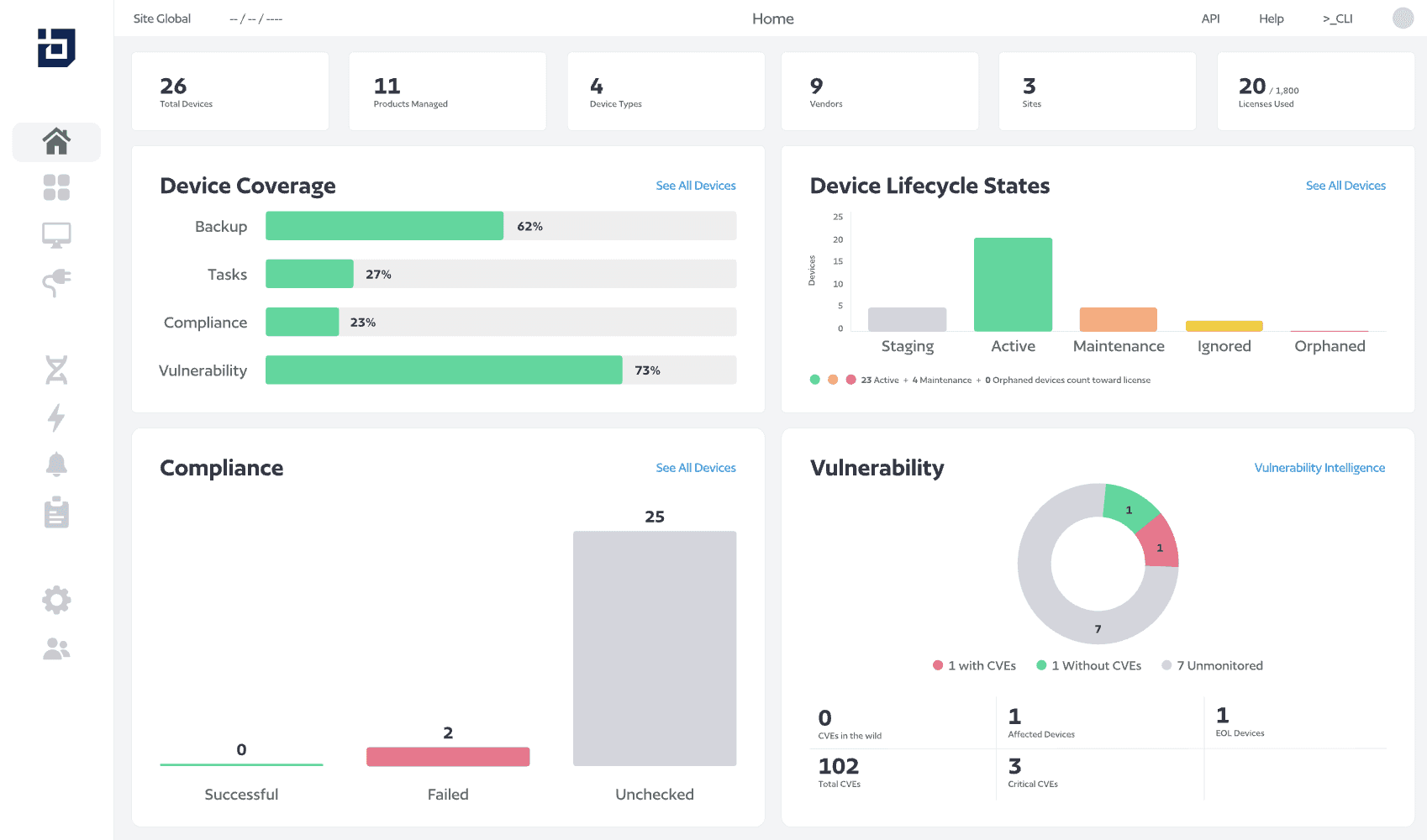
Configuration backups matter before an emergency update because network appliances often contain business-critical access rules, routing, authentication settings, and integrations. Compliance checks matter afterward because completing a change ticket is not the same as proving every targeted device reached the fixed version and retained its intended configuration. Automation provides a repeatable way to validate both the security update and the operational state that follows it.
What Security and Infrastructure Teams Should Do Now
First, identify every SMA1000 appliance and verify the exact model and running hotfix. Prioritize any 6210, 7210, or 8200v that is reachable from the internet. Apply SonicWall’s fixed hotfix immediately, using the vendor’s supported upgrade process. If an appliance cannot be updated at once, reduce its exposure as much as operationally possible and escalate the exception as an active security risk rather than routine technical debt.
Second, preserve evidence and review the exposure period. Examine appliance, authentication, network, and downstream security logs for anomalous access, unexpected administrative actions, unusual outbound connections, new accounts, configuration changes, or activity inconsistent with normal remote-access patterns. Because the vendor has not published comprehensive indicators, teams should avoid limiting the review to a single hash or address. Look for behavior that suggests the appliance was used as an entry point or execution platform.
Finally, use this event to test network-device readiness beyond SonicWall. Can the organization produce an accurate appliance inventory quickly? Are configurations backed up before changes? Can teams identify unsupported software, deploy urgent fixes across multiple sites, verify completion, and detect configuration drift afterward? Actively exploited perimeter flaws turn those operational capabilities into security controls.
Integralty helps organizations strengthen that process and apply technologies such as BackBox to improve network-device visibility, backup, compliance, and remediation.
/
BLOG